Machine Learning Force Fields
Machine-learned force fields connect electronic structure to molecular dynamics. Dr. Hasyim develops and evaluates models that predict molecular energies, forces, and electronic observables, together with sampling workflows that provide diverse configurations for their training. His work spans learned electron densities, infrared spectra, and electrolyte environments.
DenSNet and Molecular Dynamics from Learned Electron Densities
Preprint (2026) · Paper
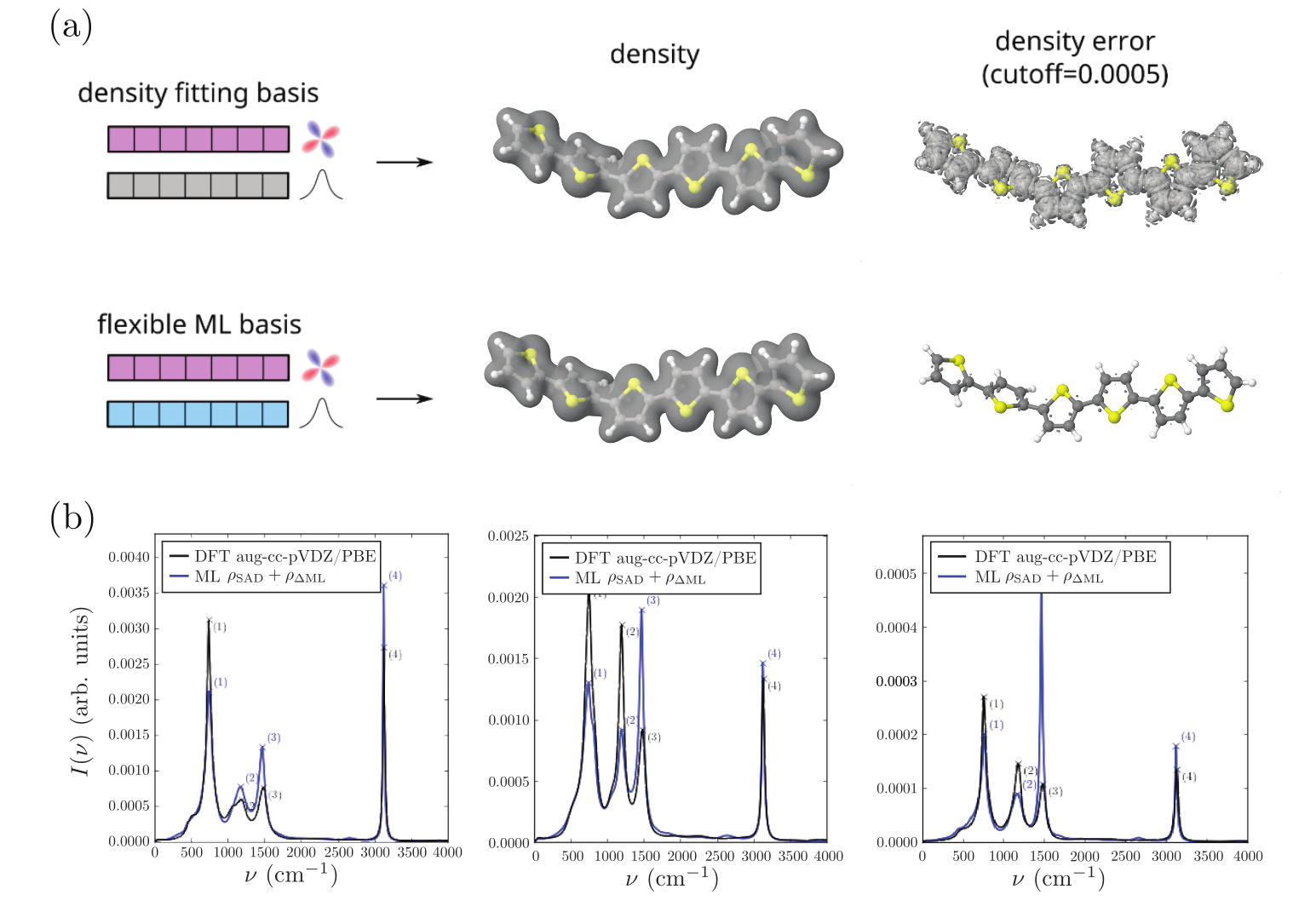
Electron density provides a connection between molecular structure, forces, and electronic observables. DenSNet uses this connection by first predicting the electron density from nuclear positions and then learning the total energy from that density. Forces derived from the energy drive molecular dynamics, while dipole moments computed from the density provide infrared spectra. To test this approach, the collaboration trained models on small organic molecules and compared their simulated spectra with gas-phase experiments. The resulting agreement tests the electronic and dynamical predictions together through a measurable molecular response. [1]
Moreover, the same approach supports tests beyond the molecular sizes used in training. Models trained on polythiophene chains of one to six monomers reproduced the main spectral features of chains containing eight, ten, and twelve monomers relative to reference quantum-chemical calculations. These results establish transfer across chain lengths within this chemical family. Mihail Bogojeski developed the core architecture. Dr. Hasyim optimized and refactored the code for production simulations and led the evaluation campaign, including the polythiophene extrapolation study and infrared-spectrum analysis. His work connects numerical accuracy to the reliability of predicted molecular observables.
Open Molecules 2025 and Sampling Electrolyte Environments
Preprint (2025; revised 2026) · Paper · Electrolyte simulation code
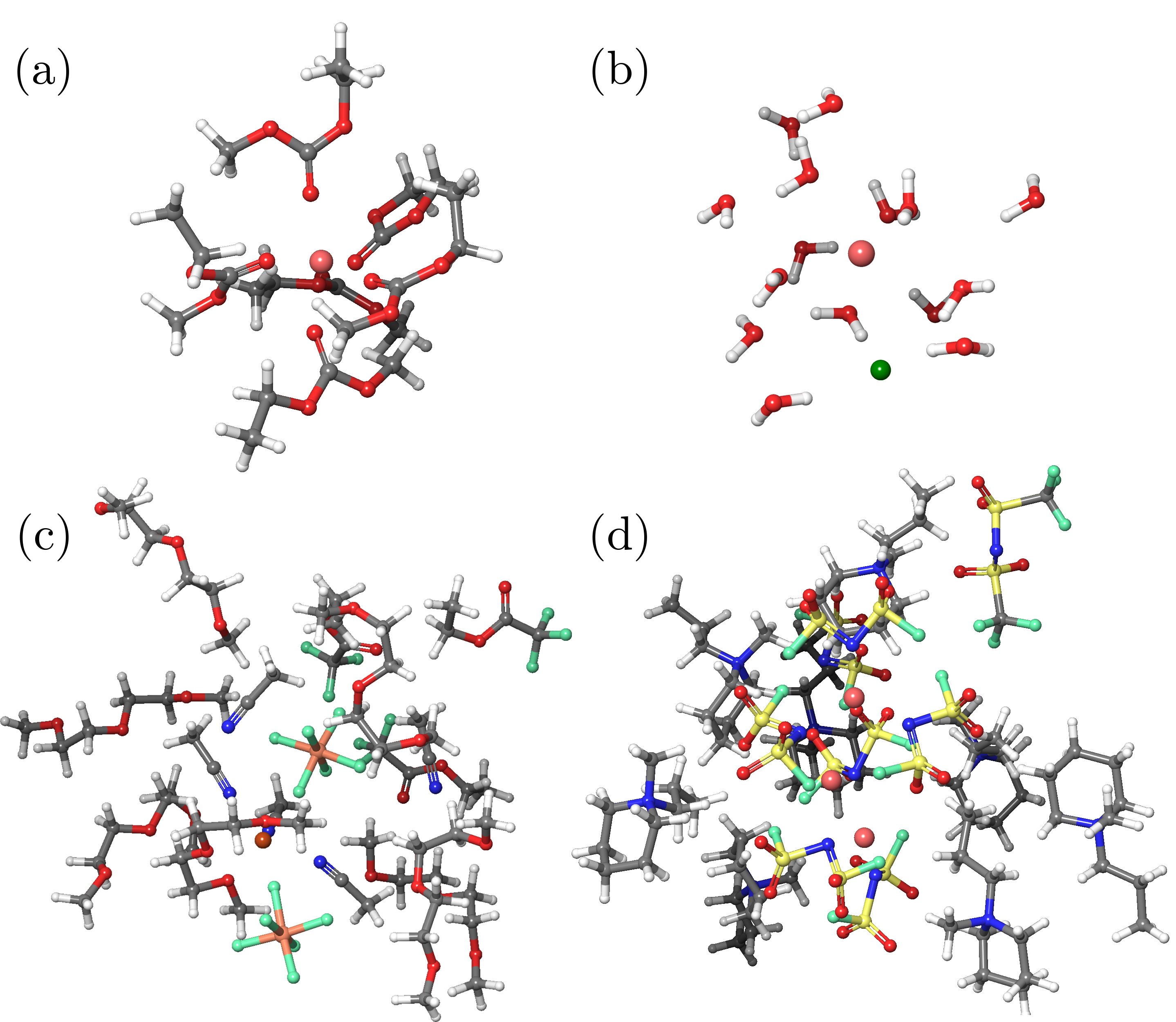
Training models for molecular chemistry requires configurations that capture changes in bonding, charge, and molecular surroundings. Open Molecules 2025 (OMol25) addresses this need through more than 100 million density-functional-theory calculations spanning biomolecules, metal complexes, electrolytes, and other molecular systems. The collaboration released these data together with baseline models and evaluations of molecular properties. For electrolytes, the central sampling problem is to represent the many local environments that ions and solvent molecules encounter as composition, concentration, and temperature vary. Such configurations provide training examples of intermolecular interactions across chemically diverse solutions. [2]
To this end, Dr. Hasyim worked with FAIR Chemistry to develop the molecular-dynamics workflow for electrolyte mixtures. Their simulations sampled combinations of ions and solvents across concentrations, temperatures, and force fields, followed by extraction of molecular clusters for quantum-chemical calculations. The workflow also used ring-polymer molecular dynamics (RPMD) to include nuclear quantum fluctuations in the sampled configurations. This contribution supplied physically sampled electrolyte environments to the larger OMol25 effort. The public code documents the simulation workflow, and Dr. Levine’s account of the collaboration, the lead scientist of the project describes their joint MD and RPMD work.
Research on committor learning and rare-event sampling is now part of Generative Modeling & Sampling.