Generative Modeling & Sampling
Generative modeling connects sampling, inference, and stochastic control through methods for learning and transforming probability distributions. These connections bring together machine learning, applied mathematics, and statistical physics, with applications in scientific simulation and discovery. Dr. Hasyim develops methods at this intersection to explore molecular distributions, evaluate generative models, and compute reaction pathways and rates. He also participated in the MSRNE Generative Modeling & Sampling Workshop, which brought these communities together around shared mathematical and computational questions.
Probing Co-Folding Models with Path Sampling
Research in progress (October 2026). Figures from Dr. Hasyim’s presentation; manuscript in preparation.
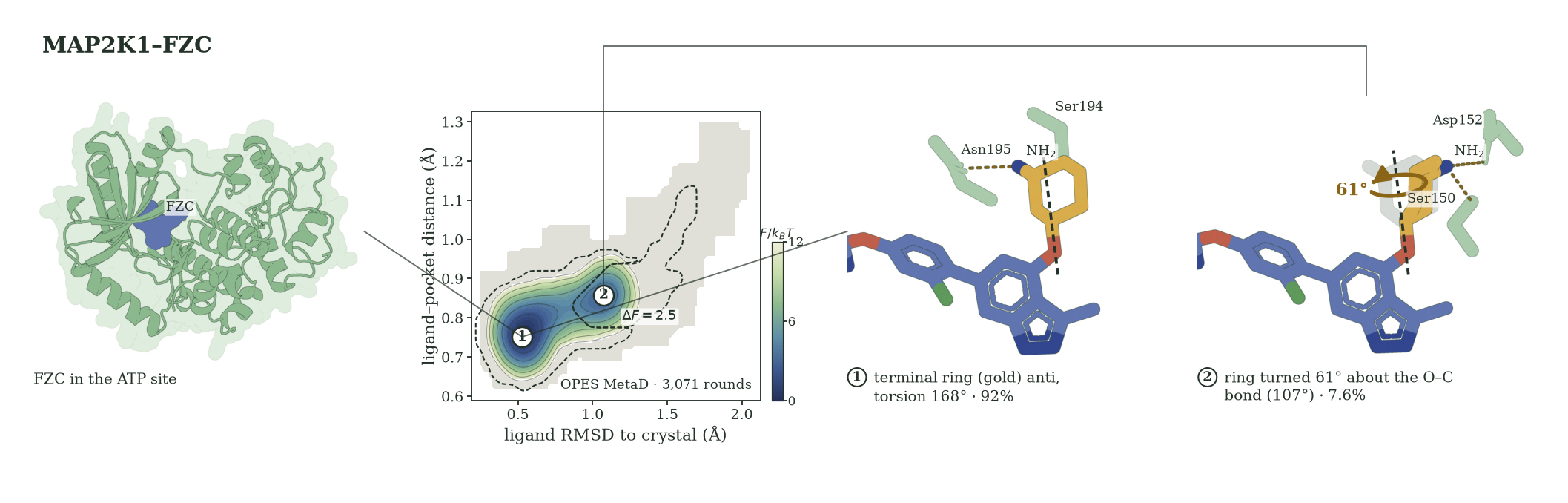
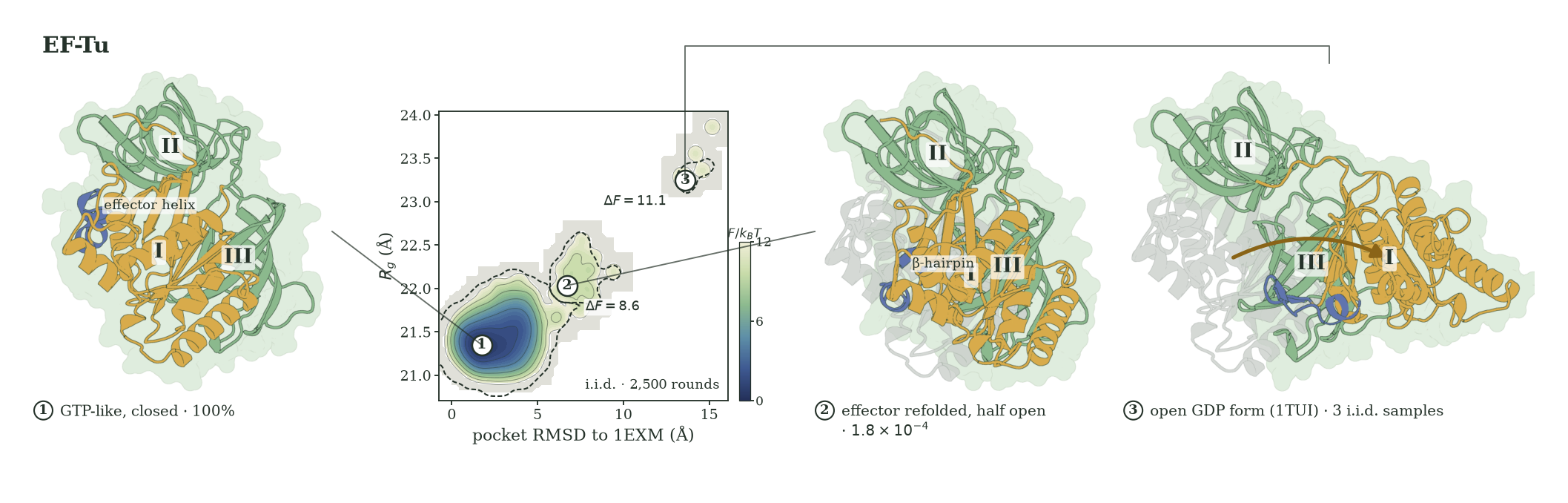
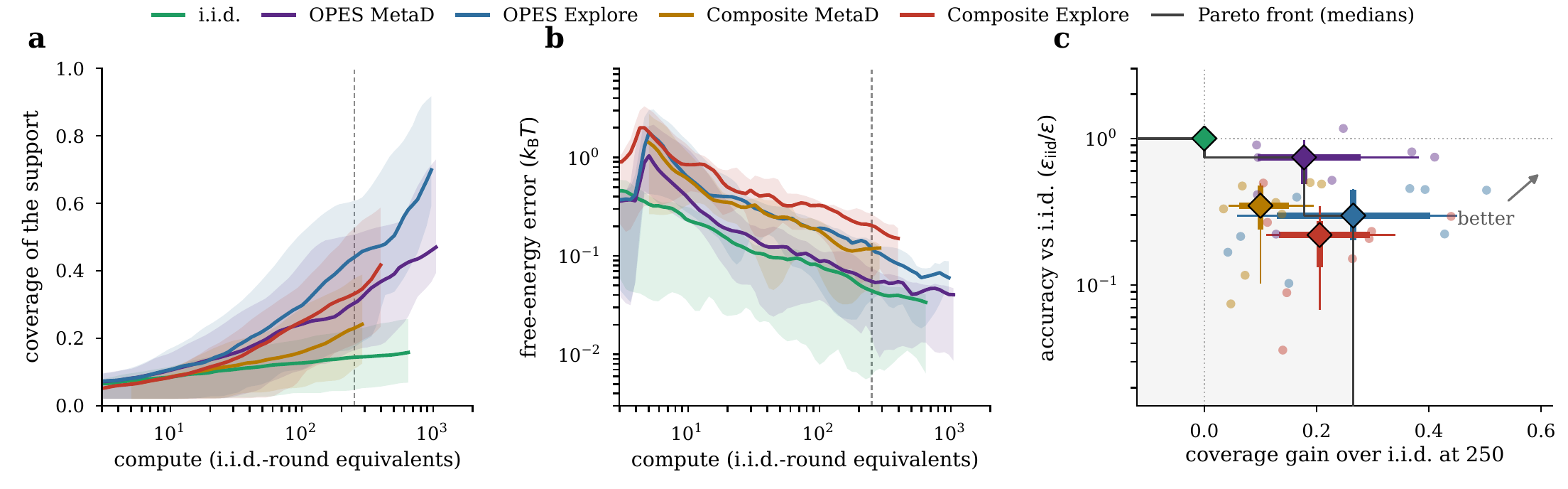
Co-folding models such as Boltz-2 generate structures from distributions learned from structural databases. To reveal what these models learn, Dr. Hasyim developed transition path sampling of their denoising trajectories, combined with adaptive biasing and replica exchange. Reweighting estimates the original model’s probabilities, allowing evaluations of rare conformations, plausible flexibility, and memorization beyond a few successful predictions. The resulting learned probability landscape, \(-\ln p_\theta(s)+C\), describes model output rather than thermodynamic free energy. The figures use \(F/k_{\mathrm B}T\) for this dimensionless quantity, with its minimum shifted to zero; the populations are those of the model. [1] [2] [3]
For MAP2K1 (MEK1), the method reveals a chemically plausible alternative FZC pose, accounting for about 7.6% of the model population, in which a terminal ring rotates by 61 degrees while the rest of the ligand remains nearly fixed. Moreover, EF-Tu sampling reveals partly open and open, GDP-like structures despite the model’s strong preference for a compact conformation, with no nucleotide specified in the input. Across eight Boltz-2 targets, a Pareto comparison exposes the trade-off between exploring rare regions and converging their probability estimates. Together, these results motivate evaluations that examine both the structures a model can generate and the distribution it assigns to them.
Computing Committor Functions with Neural Networks
The discovery of transition pathways governing kinetic processes at the microscopic level is of fundamental interest in chemistry. Common to these problems is the presence of high-energy barriers, which make the pathway discovery difficult due to the need to sample rare events.
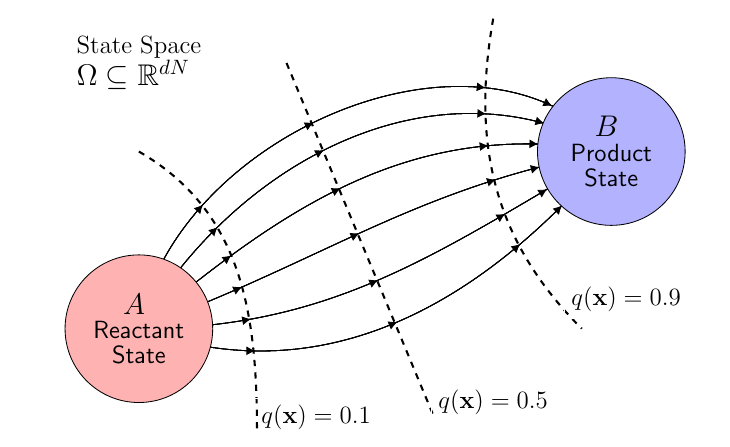
The committor function \(q(\mathbf{x})\), the probability that a trajectory starting from some initial configuration enters the product state before the reactant state, encodes the complete mechanistic details of these pathways, including the reaction rates and transition-state ensembles. Computing the committor function by traditional means is prohibitively expensive, requiring hundreds of trajectories per configuration to yield sufficient estimates along with the need for rare configurations along the transition pathway.
Dr. Hasyim’s work [4] extends the previous approach of Grant Rotskoff and Eric Vanden-Eijnden that combines importance sampling, in which high probability regions of the transition pathway are targeted, and machine learning, in which an artificial neural network approximates the committor function.
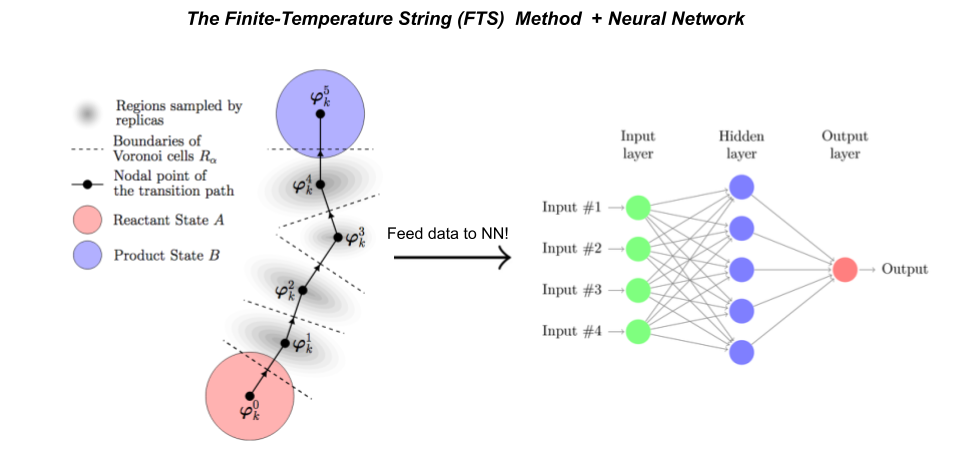
Dr. Hasyim and collaborators improved their method by adding two elements: (1) supervised learning, in which sample-mean estimates of the committor function obtained via short simulation trajectories are used to fit the neural network, and (2) the finite-temperature string method, a path-finding algorithm that enables homogeneous sampling across the transition pathway.
The research team then demonstrated these modifications on low-dimensional systems first, showing that they yield accurate estimates of the committor function and reaction rates. Additionally, an error analysis for their algorithm was developed from which the reaction rates can be accurately estimated via a small number of samples.
This work is done in collaboration with Clay H. Batton and under the supervision of Prof. Kranthi Mandadapu. Code may be found on Dr. Hasyim’s Github. Paper can be found in Ref. [4]